
Off-road tire sizes: 30, 33 and 35 inches in practice
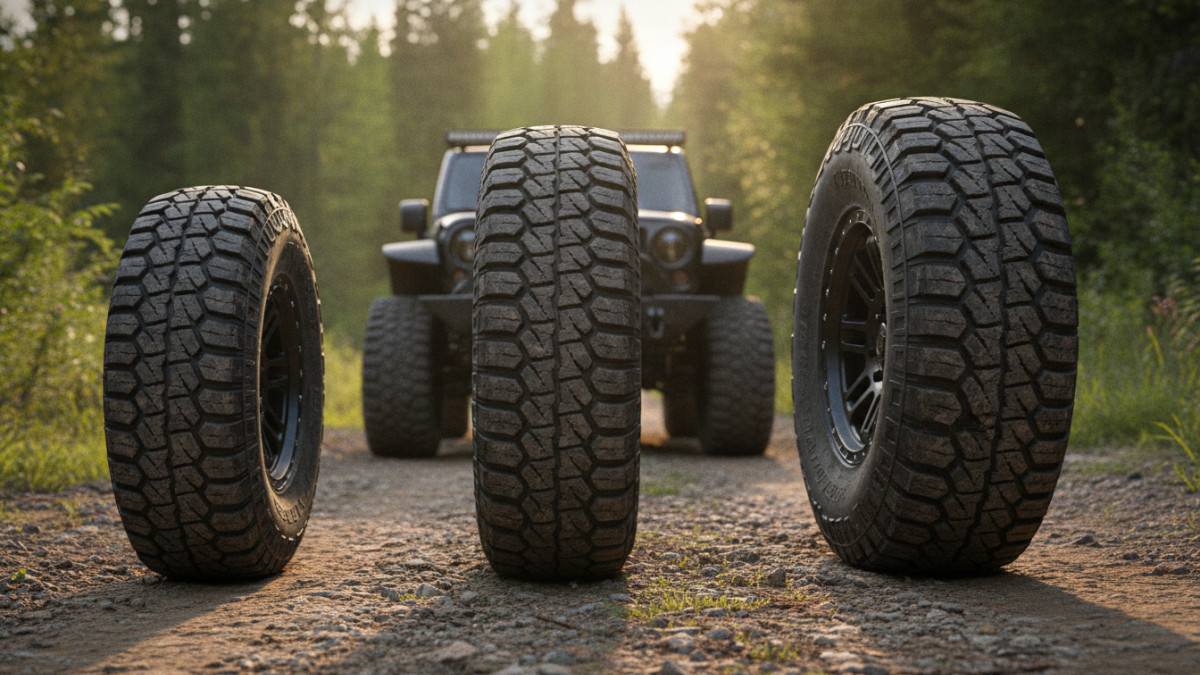
Off-road tire sizes, measured in inches, are a mystery to many drivers, as the rim is usually marked with a metric notation like 265/70 R16. At our workshop in Świdnik, we explain daily that 30, 33, or 35 inches are simply the rounded outer diameter of the wheel, not any separate system. Once you understand this relationship, choosing the right tire for your specific vehicle is no longer a guessing game. In this guide, we demonstrate conversions, discuss rims, ground clearance, and wheel arches, and calculate what happens to your car when you upgrade to a larger size.
Where do inches come from and what do they really mean?
Cal w nazewnictwie off road odnosi się do średnicy zewnętrznej całej opony, czyli wysokości koła mierzonej od ziemi do najwyższego punktu bieżnika. Zapis calowy w klasycznej formie wygląda tak: 31×10.50 R15, gdzie 31 to średnica opony w calach, 10.50 to jej szerokość w calach, R oznacza budowę radialną, a 15 to średnica felgi w calach. Większość producentów opon 4×4 odeszła jednak od pełnego zapisu calowego na rzecz metrycznego, dlatego kierowcy potocznie mówią "trzydziestki trójki" albo "trzydziestki piątki", choć na boku opony widnieje rozmiar typu 285/75 R16.
Deciphering metric notation is simple once you know the rules. In the 285/75 R16 designation, 285 is the tire's cross-section width in millimeters, 75 is the profile, or sidewall height, expressed as a percentage of the width (here, 75% out of 285 mm), and R16 is the rim diameter on a 16-inch rim. With these three values, we can calculate the outer diameter and convert it to inches. However, there's one caveat: in MT and Extreme tires, the manufacturing tolerance can be as much as 4%, so the declared "35" of one brand actually measures less than another.
For the same reason, two tires with identical metric dimensions can differ in circumference by several millimeters, depending on the tread design and casing stiffness. Therefore, in workshop practice, we don't rely on the sidewall name, but rather on the actual measured wheel, especially if the car has undergone previous modifications. Manufacturers provide both the cross-section width and the outer diameter on their catalogs, and it's these numbers that we compare before ordering a specific model.
How to convert tire size from inches to metric?
The quickest conversion method is the outer diameter formula: take the width, multiply it by the profile, double the result (a tire has two sides), and add the rim diameter converted to millimeters. For a 285/75 R16, this works out to approximately 834 mm, or roughly 32.8 inches, which in workshop jargon is rounded to 33 inches. This is why the same tire is sometimes described interchangeably as a metric tire and a .33 tire.
In practice, the formula comes down to a simple calculation: 285 times 0.75 gives you 214 mm of side height, two sides are 428 mm, and a 16-inch rim is 406 mm, so a total of about 834 mm. Dividing by 25.4 (that's how many millimeters there are in an inch) gives you 32.8 inches.
Below is a list of the most popular inch-sized sills, along with a sample metric equivalent and their actual diameter in millimeters. The numbers are based on calculations of typical sizes installed in off-road vehicles in 2026.
| Inch size | Sample metric size | Outer diameter |
| 30 inches | 255/75 R15 | approx. 764 mm |
| 31 inches | 265/75 R16 | approx. 804 mm |
| 33 inches | 285/75 R16 | approx. 834 mm |
| 35 inches | 315/75 R16 | approx. 879 mm |
The table is a starting point, not a definitive rule. Many metric sizes meet the same inch threshold: 33 inches can be achieved with a 285/75 R16, a 305/70 R16, or a 285/70 R17, but they will differ in width and rim selection. For precise fitment for a specific vehicle, we always use an off-road tire calculator, as it compares the rolling circumference of the old and new tires, a parameter that determines the odometer reading.
A good off-road tire calculator will immediately show the percentage difference in diameter, ground clearance, and circumference, as well as how much the speedometer reading will change at a given speed. This is more convenient than mental calculations, because you can see the effect of changing the tire size in inches on specific numbers before ordering anything. It's generally accepted that a safe difference in diameter from the factory is up to about 3%; above this limit, we begin to consciously interfere with the vehicle's geometry and electronics.
30, 33 and 35 inch tires: what size is it in practice?
The three most common inch-by-inch sills in the workshop correspond to the three stages of off-road vehicle upgrades. Each stage has different requirements for the body and suspension, so we've broken them down separately, based on the dimensions we actually install.
- 30-inch tires (size: approximately 762 mm, e.g. 255/75 R15 or 265/70 R16) are often factory or slightly oversized, and fit in the wheel arch without modifications on most SUVs and pickups.
- 31-inch tires (approx. 787-806 mm, e.g. 265/75 R16 or 235/85 R16) are the first real step towards off-road, usually without a lift, sometimes with a minor correction of the wheel arches.
- 33-inch tires (what size: approx. 834 mm, e.g. 285/75 R16 or 295/75 R16) in many cars require a body lift or a small suspension lift and fender extensions.
- 35-inch tires (size: approx. 879-885 mm, e.g. 315/75 R16 or 285/75 R18) are a cross-country size, which almost always involves a lift, widening and often corrections to the geometry or axle ratio.
The boundaries between these thresholds are not rigid, as the specific car model dictates. A Land Rover Defender will accommodate 33 inches more easily than a narrow Suzuki Jimny, while a Jeep Wrangler is factory-ready for larger tires than an older Mitsubishi Pajero. For this reason, before purchasing tires and rims, it's worth measuring the wheel arch space and consulting a selection guide, rather than relying solely on a table.
The weight and width of the wheel also matter, not just its height. A jump from 30 to 35 inches often adds several extra kilograms to each wheel, which puts strain on the hubs, bearings, and steering system. A wider tire increases rolling resistance and fuel consumption. Therefore, a jump of two treads at once is considered a comprehensive modification, not a simple tire change.
What don't the tables tell you: lift, ground clearance and speedometer?
This is where the part most often omitted in guides limited to calculations begins. A larger tire changes the wheel geometry, so you need to ensure it doesn't rub against the chassis, wheel arch, or bumper at full steering angle and full suspension travel. Suspension has a defined travel range, and tires flex and move in rough terrain, so a few centimeters of wheel arch clearance is a minimum, not a luxury. For 33- and 35-inch wheels, we typically combine a lift with fender flares, which also protect the paint from tread chipping.
The rim is the second piece of the puzzle: a wider tire requires a corresponding rim width, and the ET (offset) value determines how far the wheel sits in the wheel arch or how much it sticks out. A poor ET on a larger tire causes friction against the shock absorber on the inside or the fender on the outside. Therefore, we choose a complete set of tires and rims together, because changing one parameter without the other rarely ends well. You can find helpful catalogs in the section tires and rims, and car lifting components in the section suspension.
The last thing you shouldn't forget is the speedometer and axle ratio. A larger wheel diameter means the car actually goes faster than the odometer shows, because the computer calculates based on the factory circumference. In the European Union, the speedometer can overstate, but never understate, so after switching to 35-inch wheels, calibration becomes a matter of safety and compliance with regulations. A specialist reprograms the ECU, entering the actual wheel circumference, and with a significant change in size, we also consider correcting the axle ratio to regain torque and maintain the gearbox's smooth operation.
How to choose the tire size for your car?
We begin our selection by asking what the vehicle will be used for, as paved roads and cross-country trips have conflicting requirements. For mixed driving, the factory size or one size up is usually sufficient, as it doesn't require major modifications or impact fuel economy. For extreme terrain, a larger tire is selected with ground clearance and traction in mind, accepting the need for a lift, extensions, and calibration. In both cases, we adhere to the rule that the difference in circumference from the factory size shouldn't exceed a few percent, ensuring performance and proper operation of electronic systems.
It's also worth remembering the formal aspect. Changing tire sizes beyond the range permitted by the vehicle manufacturer may require an entry in the vehicle registration certificate and confirmation of compliance, and for more significant modifications, an inspection at a district vehicle inspection station. This applies especially to homologation: the tire must have a load and speed index appropriate to the vehicle's weight, as underestimating these values is a real risk on the road and grounds for questioning the vehicle's approval. It's better to plan this at the design stage than to explain it at the inspection. If you want to first understand the markings on the tire sidewall, refer to the entry about this, how to read off-road tire markings. Our experience in building cross-country rally cars shows that a well-calculated size saves a lot of hassle and adjustments later.
Xtreme4x4
Proven parts for many car models. Fast shipping and professional service. We offer consumables, braking systems, suspension, and accessories. Choose the right parts conveniently, safely, and at a great price.
piotr@xtreme4x4.pl
