
How to Read Off-Road Tire Markings: The Complete Guide
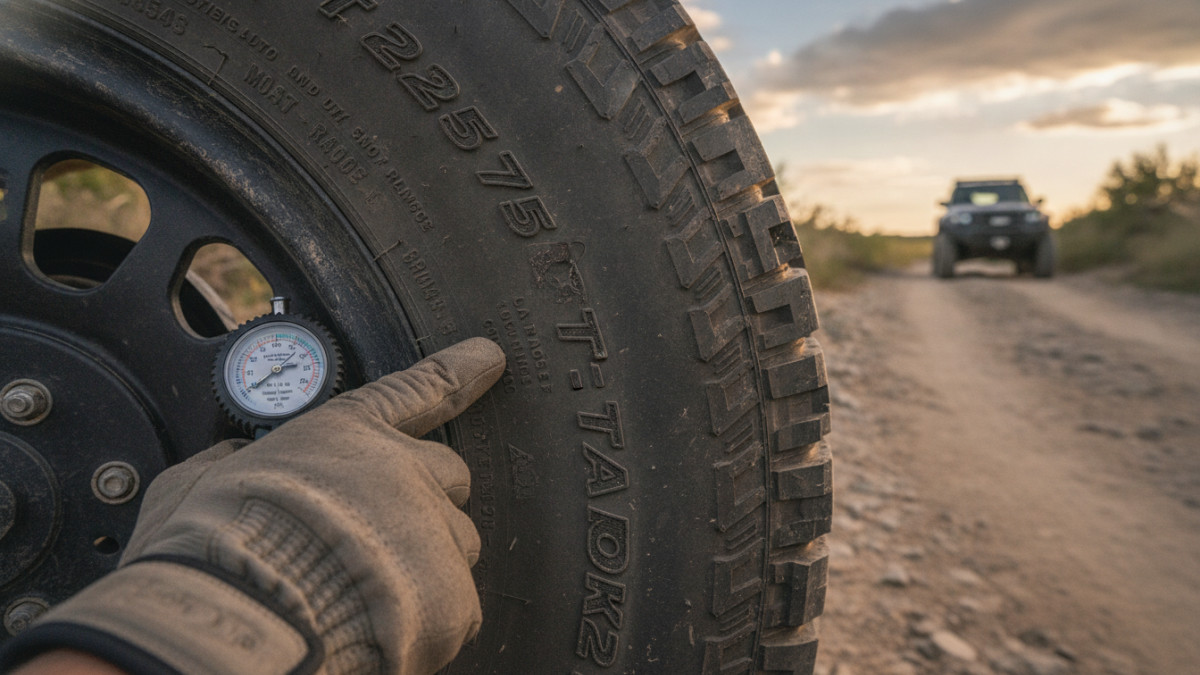
Off-road tire markings are a series of numbers and letters on the tire's sidewall, indicating the tire's size, load capacity, speed rating, and intended use. At our workshop in Świdnik, we translate these codes to customers daily, as their interpretation determines whether the rim, suspension, and lift system will work together. In this guide, we show you how to read tires step by step, from the perspective of those who install them on off-road and expedition vehicles. Without this knowledge, it's easy to buy tires that won't fit in the wheel arch or won't support a loaded Land Rover.
Where can you find off-road tire markings and what do they describe?
All important off-road tire markings can be read from the sidewall, where the manufacturer molds them into the rubber. Additional information, such as recommended pressure, can be found on a sticker in the driver's door recess or in the fuel filler cap. The tire sidewall itself is a set of layers of information: size, indexes, DOT production date, homologation code, and seasonal symbols. Each of these layers answers a different question, so we read them sequentially, not selectively.
Zanim przejdziemy do liczb, warto rozdzielić dwa światy zapisu rozmiaru, bo w segmencie 4×4 spotykamy oba naraz. System metryczny (europejski) podaje szerokość w milimetrach, a system calowy (amerykański) opisuje oponę przez średnicę zewnętrzną w calach. W naszym warsztacie częściej widujemy opony znakowane podwójnie, więc umiejętność czytania obu zapisów to podstawa przy doborze ogumienia do konkretnej generacji pojazdu.
The tire sidewall is always read in the same order: first the size, then the indexes, then the design and season designations, and finally the manufacturer and E-approval codes. The letter R next to the size indicates radial construction, which is standard today, although diagonal tires are still found on older off-road vehicles and expedition trailers. The symbol TL (Tubeless) indicates tubeless tires, and TT (Tube Type) indicates a tube-type design, which is important when selecting rims. In workshop practice, we start with the size, as it determines whether the tire will even fit under the vehicle's wheel arch.
You can see the full range of sizes and designs at offer of tires and rims, where we filter products for a specific car model. This allows you to narrow down your selection before you start deciphering each symbol individually.
What do the letters and numbers on metric tires mean?
The most common metric designation for an off-road tire, such as 265/70 R16 112T, is broken down into six components. Each component carries specific technical information that we verify before each installation.
The table below deciphers an example of the designation with which a customer comes to us most often.
| Element | Designation | Meaning |
| Tread width | 265 | tire width in millimeters |
| Tire profile | 70 | side height as a percentage of the width (here 70 percent of 265 mm) |
| Design | R | radial structure (most common today) |
| Rim diameter | 16 | rim diameter in inches |
| Load index | 112 | maximum load on one tire (here 1120 kg) |
| Speed index | T | permissible speed (here 190 km/h) |
The load index is a numerical code representing the maximum load in kilograms that a single tire can carry. For off-road vehicles loaded with expedition gear, this parameter should never be underestimated. The speed index, written as a letter, indicates the speed at which the tire can safely carry that load. We recommend never going below the value recommended by the vehicle manufacturer, as a low load index can cause the tire to overheat and become damaged under load.
How to read tire size in inches?
Rozmiar calowy stosują niemal wszystkie opony stricte terenowe i to z nim mierzymy się przy buildach extreme. Zapis 33×12.50 R15 czytamy tak: pierwsza liczba to średnica zewnętrzna opony w calach (33 cale, czyli około 84 cm), druga to szerokość w calach (12,5 cala), litera R oznacza konstrukcję radialną, a ostatnia liczba to średnica felgi (15 cali). Ten format jest dla wielu intuicyjniejszy, bo od razu widać, jak wysoka będzie opona, co przekłada się na potrzebny lift i prześwit. Szczegółowe przeliczenia cali na milimetry rozpisaliśmy w osobnym wpisie o off-road tire sizes in inches.
AT tires – what does that mean and how do they differ from MT?
AT (All-Terrain) tires are universally designed for asphalt and light off-road conditions, while MT (Mud-Terrain) tires have aggressive treads for mud and rocks. However, it's important to be clear: the abbreviations AT and MT are manufacturer trademarks, not a standardized symbol like a size or load index. There's no single standard that precisely defines where AT ends and MT begins, so tread patterns with the same designation can vary between brands.
From our workshop experience, these two types work well in different applications, which we describe below.
- AT tires: quiet ride on asphalt, reasonable traction on gravel, gravel and light mud, a good choice for an everyday car with weekend trips.
- MT tires: large, self-cleaning tread blocks for deep mud, clay and rocks, but louder and wear faster on the road.
- Hybrid tires (R/T, rugged terrain): a compromise between AT and MT, increasingly chosen by customers who drive both off-road and in the city.
- Directional MT tread: in deep mud, it disperses spoil more effectively, but requires careful installation in accordance with the ROTATION arrow.
In practice, choosing between AT and MT depends on the mix of on-road and off-road riding, not just the symbol on the sidewall. An MT tire can be surprisingly noisy and have a shorter lifespan on everyday asphalt, while an AT tire clogs up more quickly with debris in deep mud. If you're unsure between types, we've covered this topic in more detail in our guide. AT or MT tires, where we compare them point by point.
What winter symbols and additional parameters should you check in 2026?
Poza rozmiarem i typem bieżnika na boku opony terenowej znajdziemy zestaw symboli, które realnie wpływają na dopuszczenie do ruchu i trwałość. Najważniejsze z nich to oznaczenia sezonowe oraz amerykańskie kody UTQG, których w segmencie 4×4 nie da się zignorować.
Most AT and MT tires bear the M+S (Mud and Snow) symbol, but this is a manufacturer's declaration without mandatory external testing. The only real confirmation of winter capability is the 3PMSF (Three Peak Mountain Snowflake) symbol, a mountain with a snowflake, awarded after snow traction tests. Many aggressive MT tires lack the 3PMSF symbol, so as of 2026, they are considered summer or all-season tires without winter homologation, regardless of their large tread blocks.
Among American markings, customers most often ask about three parameters, which we explain when selecting expedition tires.
- DOT: identification code with the production date in the last four digits (e.g. 2424 is the 24th week of 2024), important when assessing the freshness of the rubber.
- Load Range / Ply Rating: The letter C, D or E describes the casing reinforcement, the higher the number, the greater the puncture resistance and the higher the load capacity in heavy terrain.
- LT (Light Truck): The prefix before the size indicates a tire for light trucks and SUVs, reinforced compared to the P-metric passenger version.
These details can determine whether a tire will survive a steep descent over rocks or suffer a flat on its first stretch. That's why, for cars built for cross-country rallies, we always check the load range and DOT date before mounting a set on the rims. It's also worth remembering that rubber ages regardless of mileage, so a tire with a very old production date can harden and crack on the sides, despite its deep tread.
The most common mistakes when selecting off-road tires
After years of installation in Świdnik, we see that most problems stem from reading the size alone, in isolation from the rest of the markings. Customers look at the diameter in inches, forget about the profile, load index, or load range, and then the tire rubs against the wheel arch at full turn. Choosing off-road tires is always a complex process: size, lift, rim width, ET (offset), and the permissible axle load.
Another common mistake is treating the M+S marking as a guarantee of winter driving, when without 3PMSF, the tire failed snow tests. The third is mixing speed or load ratings on the same axle, which we absolutely must not do. It also happens that customers buy larger inch tires without considering the change in rolling circumference, causing the speedometer to read lower and the on-board computer to lose fuel consumption readings. We recommend a simple approach: write down the full tire marking on the side of the current tire, compare it with the sticker in the door, and only then look for a new set. If you're planning a facelift or fender flares, we add a size change to this discussion to ensure everything works well after installation.
Xtreme4x4
Proven parts for many car models. Fast shipping and professional service. We offer consumables, braking systems, suspension, and accessories. Choose the right parts conveniently, safely, and at a great price.
piotr@xtreme4x4.pl
