
AT or MT tires: which to choose for off-road driving?
AT or MT tires are a question that comes up in our Świdnik workshop for almost every vehicle being prepared for off-road use. The answer is never "these are better," because it all depends on how many kilometers you spend on asphalt and how many in the mud. Off-road tires are divided into two main types: all-terrain (AT) and mud-terrain (MT), each designed with a different driver in mind. We'll combine our knowledge from the construction of off-road vehicles and hundreds of tire changes to help you make a decision without regrets after a thousand kilometers.
What is the difference between AT tires and MT tires?
AT (all terrain) tires are a compromise between asphalt and light off-road, with moderately deep tread and on-road comfort, while MT (mud terrain) tires prioritize aggressive traction in mud at the expense of noise and durability.
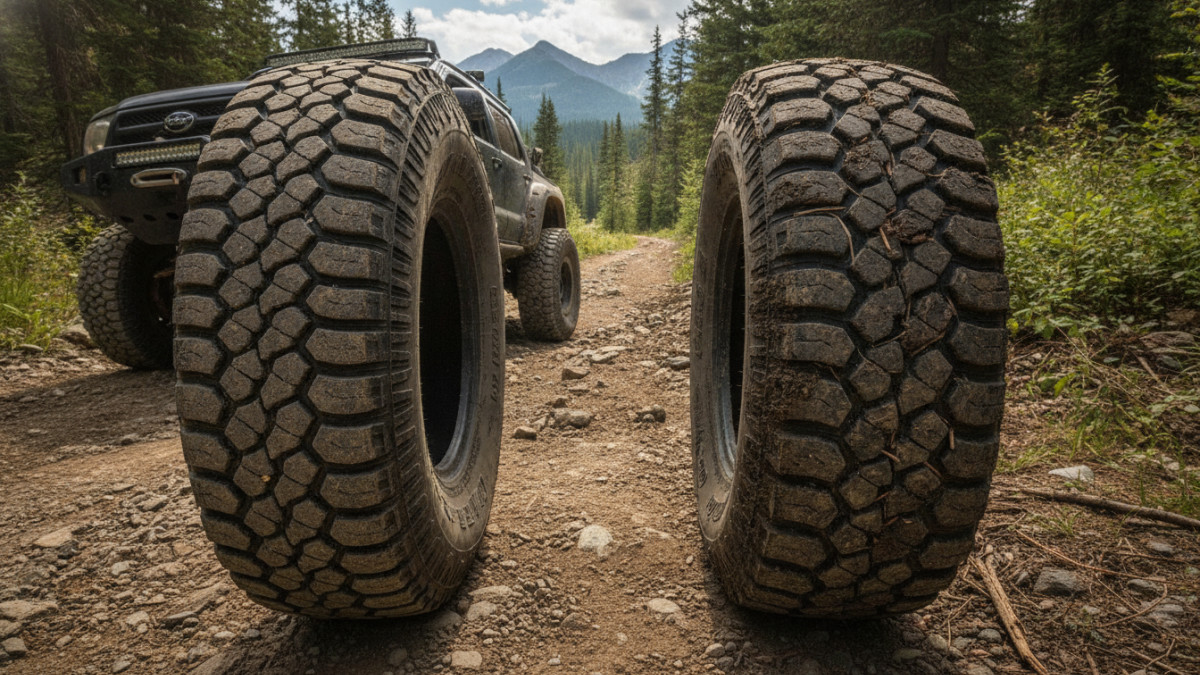
The difference starts with the tread. An all-terrain tire has medium-sized, multi-directional, and fairly densely spaced lugs. This provides decent traction on sand and gravel, while also providing a smooth ride on the road. A mud-terrain tire has large, tall, and widely spaced lugs with deep grooves. This allows it to dig into muddy ground and self-clean, but on hard surfaces, these same lugs are noisy and uneven.
The second factor is the tire's sidewall construction. MT models have thicker sidewalls, often with additional armor and a tread pattern that extends into the sidewall. This protects against cuts from sharp rocks or roots, which is crucial when driving over rocks. AT tires have moderately reinforced sidewalls, designed for comfort rather than ramming obstacles.
The third difference, less visible to the naked eye, is the rubber compound. In an all-terrain tire, the compound is more flexible, which translates into quieter operation and better traction on cold asphalt. A mud-terrain tire uses a harder, more cut-resistant rubber that handles contact with sharp rocks well, but becomes even stiffer in low temperatures and loses grip. This is why two tires of the same size can perform completely differently on the same road, even though the only visible difference is tread depth.
How to recognize the tire type by its marking?
Manufacturers almost always include an abbreviation in the model name, such as A/T or M/T, right next to the brand name. It's worth looking beyond the abbreviation itself, as actual properties can vary between brands. Before making a decision, check the full description on the tire's sidewall, as this is where information about load capacity and winter use is hidden.
These marking elements are most important for an off-road vehicle:
- Load index, i.e. the number before the speed letter, determines how many kilograms one tire can carry, which is important for a heavy pickup with attachments.
- Symbol 3PMSF (snowflake with three peaks in the background) confirms the tested properties on snow and only few AT tires have it, almost none of the classic MT tires.
- M+S marking it only talks about the tread pattern for mud and snow and is issued without testing, so it does not guarantee anything in itself.
If you want to decipher the full description step by step, we have described it in a separate post about it, how to read off-road tire markings. The abbreviation AT or MT itself is only the beginning of the story.
Comparison Table: AT vs. MT in Real-World Conditions
AT tires win on asphalt, in terms of durability, fuel consumption and winter performance, while MT tires dominate in deep terrain and mud, where the deep tread provides traction unattainable for all-terrain tires.
The following list is based on workshop observations and manufacturer data as of 2026. Treat these numbers as approximate, as a specific model may differ from the average for its type.
| Criterion | AT (all terrain) tires | MT (mud terrain) tires |
| Asphalt | Stable, short braking distance, predictable | Less precise, longer braking distance in the wet |
| Terrain and mud | They cope with light and medium terrain | Excellent, self-cleaning tread bites into the ground |
| Noise | Noticeable, but not intrusive on the road | Loud and tiring on long road trips |
| Vitality | Often 50-70 thousand km with normal use | Usually 30-50 thousand km, wear is faster on asphalt |
| Fuel consumption | Lower, less rolling resistance | Higher by up to several percent due to the aggressive tread |
| Winter | Some models with 3PMSF, decent in snow | Poor on ice and packed snow, no winter homologation |
The table clearly shows that no tire is perfect for everything. The more you gain off-road, the more you give back on the road, in your wallet at the gas station, and in the comfort of your ears. This is a natural compromise built into the physics of tread design.
It's worth adding context to the lifespan number, as it's the most emotive. Tire mileage depends not only on type but also on driving style, pressure, and how much time the tire spends on hot asphalt. The same MT set that wears out after 35,000 km on the road can last much longer off-road, as softer surfaces wear out the treads less. An all-terrain tire, on the other hand, rarely causes surprises because its wear is evenly and predictably distributed, which is a significant advantage when planning your tire budget.
How does tire type affect everyday driving on Polish roads?
In Polish conditions, where most drivers cover hundreds of kilometers on asphalt, AT tires are more comfortable on a daily basis, while MT tires begin to make noise and wear out after the first long trip.
The reality is that even a dedicated off-roader reaches the wilderness by public roads. If you're driving two hours from Lublin or Świdnik on the highway to a rally, MT tires will make their presence felt with a buzzing sound in the cabin and higher fuel consumption throughout the entire trip. With all-terrain tires, the same commute is simply quieter and cheaper, and you often won't even notice the difference off-road if you're riding on gravel and light mud.
The Polish climate adds a second factor. In winter, we drive on snow, slush, and ice, and the aggressive MT can be downright dangerous, as the hard compound and wide lug spacing offer poor grip on packed snow. The AT tire, with 3PMSF certification, handles these conditions much better and is often the only off-road tire that can be realistically driven year-round. This distinction saves many of our customers from buying a beautiful but impractical tire.
There's also the issue of tire pressure, which many drivers overlook. Both AT and MT tires behave differently at low pressure off-road, and they need to be inflated after hitting the pavement. We've summarized the principles of this process in the article about off-road tire pressure, because the right pressure can change the behavior of the tire more than its type itself.
When to AT and when to MT? The workshop's verdict.
Choose AT tires if you do more than half of your kilometers on asphalt and only go off-road for fun, and MT tires only if mud and rocks are your daily reality and your car lives off-road.
In our workshop, we always consider the proportion of use, not the dreams of cross-country driving. From our experience in cross-country rallies, we know that a car built for competition and one driven primarily in the city are two different worlds, although both can be off-road. Therefore, before recommending a specific model, we ask about the annual mileage, routes, and whether the car has one or two sets of wheels.
This simple breakdown works for most of the drivers we serve:
- Mostly asphalt, sometimes gravel and light mud this is a classic task for an AT tire, preferably with 3PMSF homologation for winter.
- Half road and half off-road this is a situation where a more aggressive AT or intermediate type works well before you go for full MT.
- Mostly off-road, mud, rocks, work or expeditions this is the moment when the MT compensates for its shortcomings with a real advantage in traction.
The most common mistake we see is buying MT tires "just in case" because they look intimidating and match the car's styling. After a few months, such a driver comes back asking why they're burning more fuel, making more noise, and slipping in the winter. If you're torn between two sets, the cheapest solution is a good MT tire for everyday use and a separate MT tire set for the racing season. You can find the full range in our category. rims, accessories and tires.
The decision between AT and MT therefore comes down to an honest assessment of where you actually drive. All-terrain tires are a safe choice for the vast majority of off-road vehicle users in Poland, while mud-terrain tires are a tool for those who truly live off-road and accept its cost on the road. If you have any doubts about the specific size and model for your vehicle, come visit us or call us, and we'll select tires that suit your driving style.
Xtreme4x4
Proven parts for many car models. Fast shipping and professional service. We offer consumables, braking systems, suspension, and accessories. Choose the right parts conveniently, safely, and at a great price.
piotr@xtreme4x4.pl
