
4x4 wheel arch extensions: when are they necessary and what the regulations say
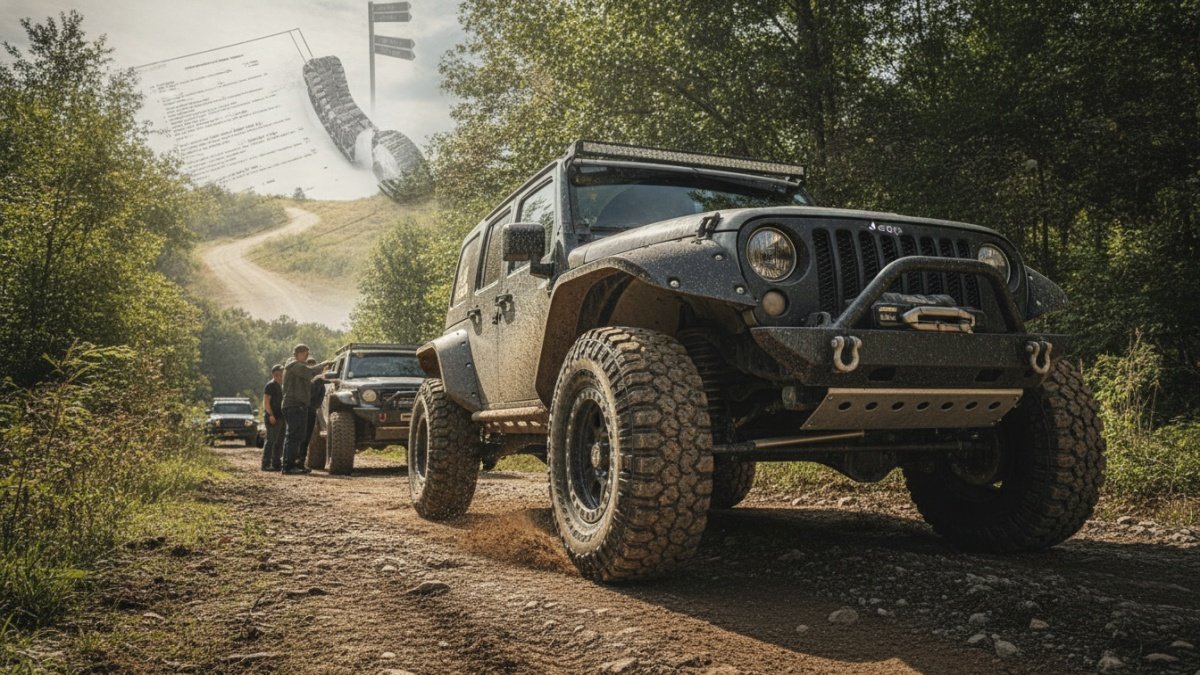
Fender flares on off-road vehicles are rarely a purely aesthetic decision. They're usually a consequence of something else: a wider tire, a rim with a smaller offset, or spacers added after a facelift. The wheel extends beyond the vertical outline of the fender, and that's when the real problem begins, as mud flies onto the paint and onto passing traffic. The diagnostician at the vehicle inspection station has every right to overlook this. Below, we'll explain when fender flares are actually necessary, how many millimeters of wheel offset each modification creates, and what exactly the diagnostician checks.
When do fender extensions on an off-road vehicle become necessary?
The limit is surprisingly simple: if the tire tread extends beyond the vertical projection of the wheel arch, the vehicle no longer meets the technical requirements, and wheel arch extensions are no longer a matter of taste. In the workshop, this moment is repeated in the same configurations, regardless of whether the vehicle is a Land Rover Defender, Nissan Patrol, Jeep Wrangler, or Toyota Land Cruiser on the lift.
Before ordering a set, check which scenario applies to your car, as the required profile width depends on it:
These changes almost never occur singly. A customer comes in for tires, adds rims, returns two months later for spacers, and suddenly the wheel is 50 mm outside the rim. Then, the appropriately wide wheel arch extensions for off-road vehicles are the only way for the car to remain compliant without reversing the modifications.
How many millimeters does a change in rim ET and spacer of a given thickness give?
ET, or rim offset, is the distance between the rim's contact plane with the hub and the geometric centerline of the rim. The lower the ET value, the more the wheel sticks out. The relationship is linear, and this is precisely the number missing from most guides: every millimeter of difference in ET translates to exactly one millimeter of wheel offset, and with wheel spacers, the same principle applies directly.
The table below shows how individual modifications translate into the wheel moving beyond the factory position and into the increase in wheel track:
| Modification | Wheel exit to the page | Wheel track increase |
| ET30 changed to ET0 | 30 mm | 60 mm |
| ET30 converted to ET-12 | 42 mm | 84 mm |
| Passage distance 25 mm | 25 mm | 50 mm |
| 285 tire instead of 245 on the same rim | 20 mm | without changes |
| ET0 plus 25mm spacer plus 40mm wider tire | 75 mm | 110 mm |
The factory fender flares on most off-road vehicles have 15 to 25 mm of clearance above the tire bead, so the first stage of modifications usually still fit. The problem arises when adding them up: the configuration in the last row requires a profile width of at least 75 mm, and in reality, 80-85 mm, because wheel travel and suspension movement must be factored in. Extensions sold as "50 mm" therefore cover either the ET0 or the spacer alone, but not both.
Change the rim ET or fit spacers to the factory rims?
The geometric effect of both solutions is identical, but the load on the system differs. The spacer moves the wheel but leaves the original rim, which increases the bearing's load arm in the same way as with a low ET. For spacers above 25 mm, only bolt-on versions with their own pins and centering ring are viable, as through-hole models shorten the bolt engagement in the hub thread.
The rest of the differences come down to budget and service. rim spacers It costs a fraction of the price of new rims and allows you to reverse the change in an hour, but requires checking the torque every season. New rims with the correct ET are the ultimate solution, without an additional connector in the chassis, but only make sense if you plan to change the rim size anyway.
What does the diagnostician check during an inspection and what does the tread coverage look like?
During a technical inspection, the car is placed on a flat surface with the wheels straight ahead, and the technician looks vertically down along the edge of the wheel arch. They assess one thing: whether the fender covers the entire width of the tread. They don't measure with calipers or count millimeters, but rather visually assess whether, when viewed from above, there's visible rubber protruding beyond the outline. If the tire protrudes even a few millimeters, the test result may be negative, and the car is placed on the list for repairs.
Here we come to a point rarely addressed explicitly: the regulation mentions covering the wheel, but it doesn't specify the measurement method or tolerance. Interpretation is left to the diagnostician and, in reality, varies between stations. Some diagnosticians allow a car to pass if the extension covers the tread, even though the extension is bolted on without any mention in the registration document. Others also check to make sure the extension doesn't break off before the fender edge, leaving a section exposed above the shock absorber. When planning a post-modification inspection, ask the specific station about their approach beforehand, as this saves you one trip and one fee.
Do wheel arch extensions need to be entered in the registration certificate?
The extensions themselves do not change the technical data recorded in the vehicle's certificate of conformity, as long as they fit within the vehicle's width specified in the certificate of conformity. The problem begins with wide profiles: a set adding 80 mm per side increases the vehicle's width by 160 mm, a value that differs from the document. In such a situation, the station may request a test to verify compliance with the technical requirements and annotate the document. We describe the regulations based on the practice in force in 2026, with procedures varying depending on the motor vehicle department.
Blind rivet or glued extensions: which will last longer?
The mounting method determines whether the set will last two seasons or ten. Versions bolted on with pop rivets require drilling holes in the fender lip, which sounds drastic, but it creates a mechanical connection resistant to yanking branches and hitting rocks in the field. For durability, each hole must be sealed with an anti-corrosion agent before the rivet sets in, as the bare metal beneath the plastic begins to rust within a single winter.
Adhesive extensions are installed with double-sided acrylic tape, usually supported by structural adhesive on the edges. They don't damage the sheet metal, so the car can be restored to its original condition, but they require careful surface preparation: degreasing, primer, and installation at temperatures above 15 degrees Celsius. Below this threshold, the tape doesn't achieve its full bond strength, and a gap may appear under the edge during the first pressure wash.
| Criterion | Rivet mounting | Adhesive mounting |
| Durability in the field | 8-10 seasons, resistant to snagging | 3-5 seasons, sensitive to washing and frost |
| Bodywork interference | Holes in the fender, requires securing | No holes, return to factory condition |
| Set assembly time | 4-6 hours | 2-3 hours plus 24 hours for bonding |
| Risk of corrosion | Realistic in the absence of anticorrosion | Minimal |
In vehicles that exclusively drive on asphalt, adhesive bonding is more than sufficient. In expedition and cross-country vehicles, we only install riveted versions, because a bonded profile caught on a bush at 30 km/h can come off along with a piece of the paint.
How to choose wheel arch extensions for a specific model and avoid making a mistake?
The selection begins with measurement, not a catalog. Place the car on straight wheels, place a plumb line against the outer edge of the tire shoulder, and measure the distance to the fender edge. The resulting number is the minimum the profile must cover, plus 15 mm for suspension movement and any future spacers.
The order of assembly is important because some errors only become apparent after putting everything together:
This last point is often neglected, and loose bolts with a wider spacing can lead to holes being punched in the rim and vibrations at 80 km/h. If you're planning a set of rims for your final setup, aluminum rims for off-road vehicles Choose an ET that matches the width of the extensions, instead of correcting the geometry with spacers after the fact. It's cheaper than two fittings and one visit to the inspection station, which ends with a negative result.


Xtreme4x4
Proven parts for many car models. Fast shipping and professional service. We offer consumables, braking systems, suspension, and accessories. Choose the right parts conveniently, safely, and at a great price.
piotr@xtreme4x4.pl
