
LED work lamps in off-road vehicles: strip, approval and installation
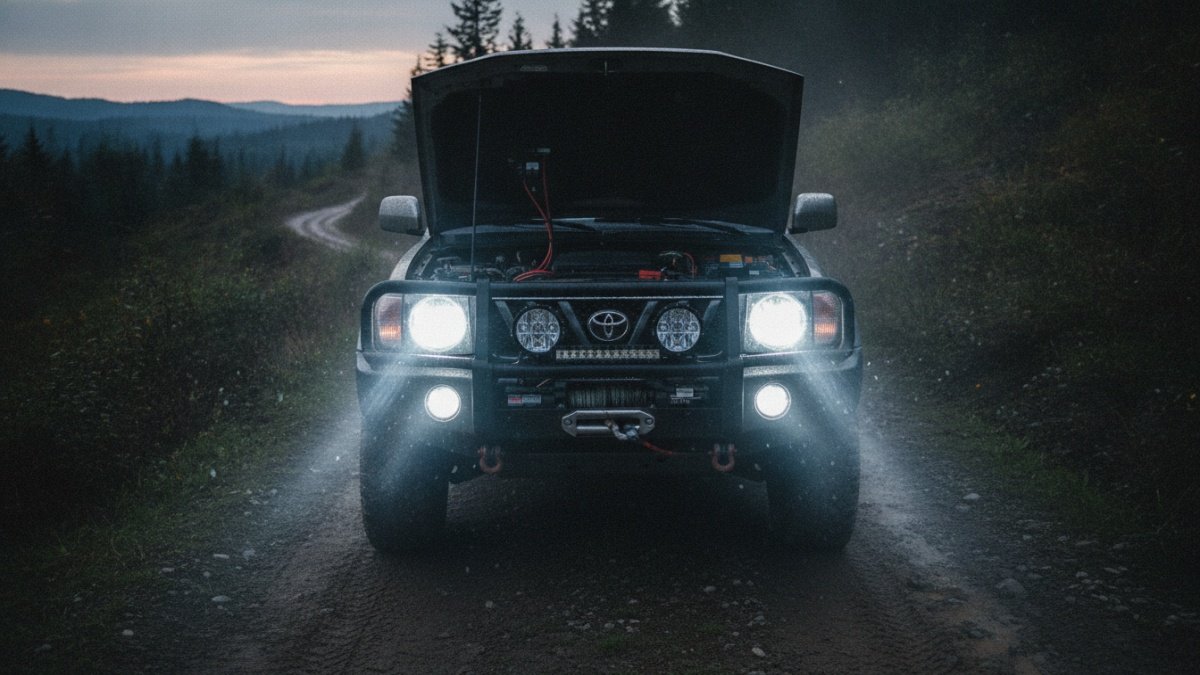
We install LED work lights more often than any other accessory after a facelift and tires. A customer arrives with a clearance strip, asks for a quick connection to the positive, and is surprised when we explain that the issue has three layers: regulations, electrical, and the actual light output of what they're holding. We break them down below, just as it looks at the stand in Świdnik.
LED work lamp vs. E-approved headlight: what is allowed on the road?
Lamp approval isn't a single stamp, but a set of UN/ECE regulations. A headlight approved for public road use has an E symbol on the lens in a rectangle with the country number (E1 for Germany, E4 for the Netherlands, E20 for Poland), next to it the regulation number (usually R112 for long-range, R149 for newer designs), and a reference number. R10 also stands for electromagnetic compatibility, as the diode's current driver can interfere with radios and sensors.
The reference number is the most frequently overlooked parameter. The sum of these numbers for all the high beams in the car, including the factory headlights, cannot exceed 100. The factory high beams in a Hilux or Defender typically consume 20 to 40 points, leaving 60 to 80 for additional lamps. With a strip claiming 50 points per lamp, the margin for maneuver disappears after the first pair.
A work lamp is a different category of equipment. It usually carries only a CE marking, sometimes R10, and is designed to illuminate the machine's work area, not the road ahead. Its beam is diffuse and unadjustable, so it blinds all oncoming traffic. While the law doesn't prohibit its use on a car, it prohibits its use while driving on public roads.
| Lamp type | Marking on the housing | Where can it be used? |
| Homologated spotlight | E + country, R112 or R149, reference number | public road, with traffic lights |
| LED work lamp | CE, sometimes R10 | closed area, out of public traffic |
| LED strip without markings | no symbols | off-road, requires covering on the route |
How to legally connect LED work lights without approval?
The standard installation is based on a 12V/40A relay and two control circuits connected in series. The coil (pins 85 and 86) receives power from the high beam circuit, and the dashboard switch is located in the same circuit. Therefore, the additional light won't turn on by itself: you must have the high beams on and arm the headlights separately. They automatically turn off when you switch to low beam, which is required for road-legal lighting.
We connect non-approved lamps identically, but we move the switch to a circuit separate from the road lights so the driver doesn't accidentally turn them on while driving. We also provide covers, as covering the lampshade on a public road is the easiest way to prove the lamp isn't in use. Set from the category controls and switches does this without cutting the factory harness.
Before a long route, we go through a short list of things that the patrol checks during a road check:
The regulations regarding additional lighting (as of 2026) are interpreted in the field by roadside inspections, not by the lamp manufacturer. The same set can be passed without a word and questioned 200 kilometers away.
How much light does a car LED strip actually give and what do lumens mean?
The 30,000 lumens claim on the packaging almost never describes the light output from the lamp. Manufacturers quote raw lumens, which is the theoretical sum of the lumens from the LED chips themselves at nominal current and a junction temperature of 25 degrees Celsius. In a real lamp, the chip heats up to 80 degrees Celsius and loses 10 to 20 percent of the lumen output, the current driver consumes another few percent, and the reflector and shade absorb the rest. This leaves 55 to 70 percent of the package's value, or 16,500 to 21,000 lumens of the claimed 30,000 lumens.
A more sensible parameter is the illuminance in lux at a specific distance. Manufacturers who reliably measure it provide a value such as 1 lux at 450 meters or an intensity curve in candela. This value is measurable with a lux meter and comparable between lamps because it takes into account the reflector geometry. Two lamps with identical power can differ in range by up to two times, because one diffuses the light to 120 degrees, while the other focuses it in a narrow cone. When choosing a model from the offer LED strips the question about lux over distance says more than the entire marketing description.
Spot, flood or off-road combo beam?
Spot is a cone with an angle of approximately 8 to 15 degrees, designed for maximum range. It excels on gravel roads and long straights, where visibility 300 meters ahead is crucial. Flood spreads the light over 60 to 120 degrees, illuminating the roadside, ruts, and obstacles next to the vehicle. On cross-country trips, at 15 kilometers per hour and turning between trees, Flood wins, as the spot then illuminates several dozen meters further than the driver can see.
The combo combines both systems in one housing: the center of the strip acts as a spot, the outer modules as flood. However, with short strips up to 20 inches, neither of these zones has full power, so a pair of separate lamps is better suited for an expedition vehicle: a spot high up, and a flood on the bumper.
Power consumption of a 240W strip: what wires and fuse?
A 240W strip draws approximately 17.4A at an on-board voltage of 13.8V, and with the engine off and a voltage of 12.0V, the current increases to 20A. A short pulse occurs when switching on, as cold diodes have lower resistance. Therefore, the installation should be designed for a continuous load of 20A, with a margin.
For a wire route from the battery to the strip of approximately 4 meters, a 4 mm² cross-section is required. A thinner 2.5 mm² wire produces a voltage drop of around 0.6 V over this length, which reduces the brightness by several percent and heats the insulation. A 25 A fuse should be mounted no further than 30 cm from the positive terminal, as it protects the wire, not the lamp. Grounding is carried out using a separate wire of the same cross-section to a ground point.
| Power of the set | Current at 13.8 V | Wire cross-section | Fuse |
| up to 60 W | about 4.3 A | 1.5 mm² | 10 A |
| 60 to 120 W | about 8.7 A | 2.5 mm² | 15 A |
| 120 to 240 W | about 17.4 A | 4 mm² | 25 A |
| over 240 W | over 17.4 A | 6 mm² | 40 A |
Another issue is the alternator capacity. A 1990s off-roader has a 65- to 90-amp alternator, which leaves little for the lights, blower, and windshield defroster. Adding 20 amps for off-road lighting with the winch running results in a flat battery. In CAN-Bus vehicles, connecting the relay coil directly to the headlight circuit also triggers a blown bulb error, as the controller measures the current draw.
12V LED halogen or dedicated LED lamp for off-road vehicles?
A 12V LED halogen lamp, i.e., an H4 or H7 insert with diodes inserted into the factory headlight, is tempting due to its price and ease of installation. However, the reflector is designed for a halogen bulb with a specific geometry, and the diode has a different luminous surface shape. The light spreads beyond the designed beam, allowing the driver to see brighter just ahead of the hood while blinding oncoming traffic. This retrofit is not homologated for the Polish market and can result in a negative result on a roadworthy inspection.
Dedicated LED lamps have a reflector or lens designed for a specific chip, so the beam is sharply focused and predictable. However, when purchasing, it's important to consider parameters omitted from the descriptions:
You won't find any of this information on the box, so ask for the catalog card before purchasing.
Where to mount lights on the roof, bumper and bullbar?
Roof-mounted lighting provides the best range, but it has a drawback that becomes apparent only on the road. The light reflects off the hood and creates a bright spot in front of the windshield, preventing the driver's eyes from adapting to the darkness further away. In rain and dust, the effect is magnified several times as the beam illuminates the suspension above the car. Therefore, roof lights are considered supplementary lighting, not the main light source on a crossing.
The bumper and bullbar are a more convenient position: less reflection, shorter cable routing, and easier access for repairs. Exposure to impacts and mud is a limitation, so we choose designs with a metal bracket and cover. You can find a model tailored to your specific bumper or grille among lamps dedicated to the car model, where there's no need to drill into the sheet metal. Separating the light into a lower working zone and an upper, long-range zone works better than one strong strip.
Xtreme4x4
Proven parts for many car models. Fast shipping and professional service. We offer consumables, braking systems, suspension, and accessories. Choose the right parts conveniently, safely, and at a great price.
piotr@xtreme4x4.pl
