
12V car compressor for off-road vehicles: what is the efficiency?
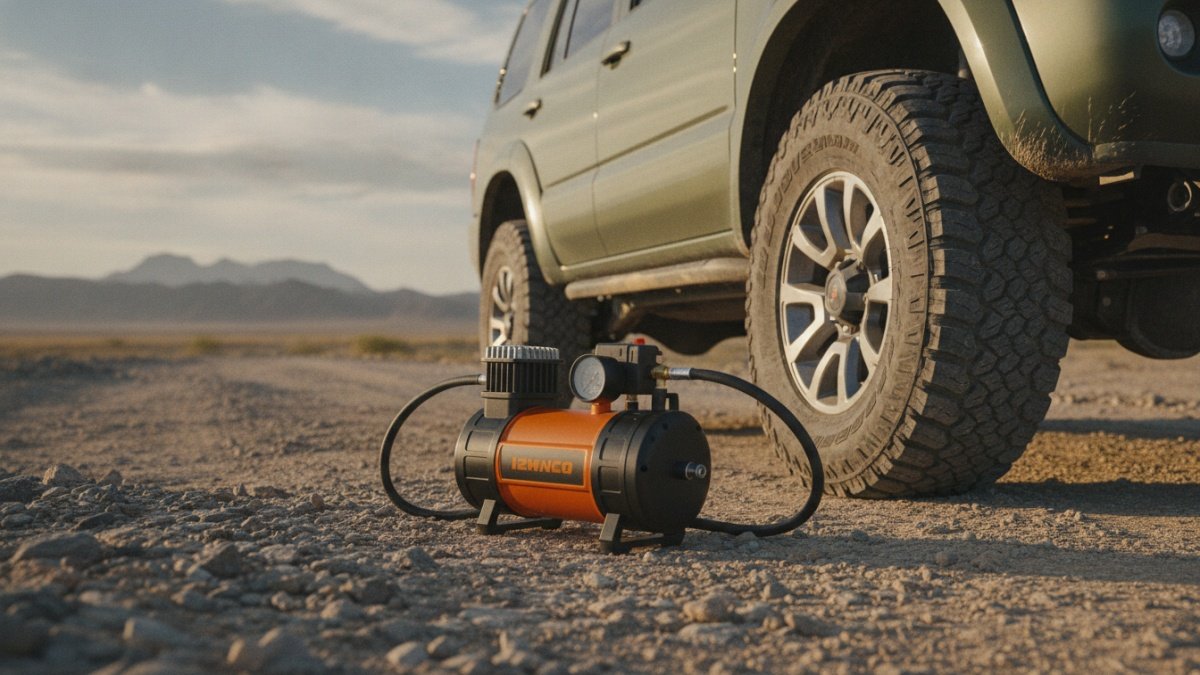
A 12V car compressor is the easiest tool to miscalculate. The box boasts a striking number of liters per minute, but when you put it in the tire, it turns out that inflating takes three times longer than the catalog suggests. We see this every season in the workshop: someone returns from a trip where they pumped four 33-inch tires for forty minutes because they bought a device designed for bicycle inner tubes.
Below, we break down the parameters: where does the difference between catalogue and actual performance come from, how much air does an off-road tire actually need, and why the duty cycle is sometimes more important than just liters per minute.
How many liters per minute does a compressor really produce?
The performance specifications almost always refer to free flow, measured at zero pressure, i.e., with the outlet open and no hose connected. A manufacturer might honestly write 72 l/min and be right, but at that point the compressor isn't doing any work. As the piston begins to struggle against the tire's back pressure, performance drops: some air flows back through the valves, and the electric motor slows down under load.
The extent of the loss depends on the design. Cheap single-piston diaphragm compressors can lose up to 55-60% of their declared capacity at 2.0 bar. A decent dual-piston compressor with metal cylinders and a finned head typically loses 25-35%. Therefore, two devices with the same number on the packaging can have operating times that differ by as much as two-fold.
| Catalog performance | Design | Actual flow at 2.0 bar | Power consumption |
| 35 l/min | single-piston, market | 15-20 l/min | 10-14 A |
| 72 l/min | single-piston reinforced | 40-45 l/min | 25-30 A |
| 160 l/min | two-piston | 100-115 l/min | 50-60 A |
The values are based on measurements at our test bench (as of 2026), at a voltage of 13.8 V and a 6 m hose. When powered by a weakened battery, when the voltage drops to 12.0 V, each of these numbers must be reduced by approximately 151 TP3T. Therefore, compare devices based on their actual flow rate under operating pressure, and if the manufacturer does not provide it, treat the catalog liters as a marketing value. Equipment with the specified flow rate under load can be found in the category compressors and accessories.
How long does it take to inflate four 33-inch tires from 0.8 to 2.0 bar?
Opona 33×12,50 R15 mieści około 65 litrów powietrza. Podniesienie ciśnienia z 0,8 do 2,0 bar oznacza wtłoczenie dodatkowych 1,2 bara, czyli mniej więcej 78 litrów powietrza atmosferycznego na jedno koło. Cztery koła to blisko 310 litrów. Ta liczba nie zależy od marki kompresora, wynika wyłącznie z fizyki, więc świetnie nadaje się do porównań.
| Compressor | Real flow | Pure pumping time | Real time with breaks |
| 35 l/min (catalog) | approx. 18 l/min | approx. 17 min | 25-35 min |
| 72 l/min (catalog) | approx. 43 l/min | approx. 7 min | 8-10 minutes |
| 160 l/min (catalog) | approx. 110 l/min | approx. 3 min | 3-4 minutes |
The difference between the latter two columns stems from the cooling down time. The cheapest compressor for inflating tires requires the most cooling down time because it heats up the fastest and runs the longest. We've described the method of reducing pressure before hitting the sand separately; the return journey is crucial here, as the compressor determines whether you'll be idling for fifteen or half an hour before hitting the pavement.
How to convert inflation time to your own tire size?
The math is simple: multiply the tire volume in liters by the pressure increase in bar and divide by the compressor's actual flow rate. Approximate capacities are approximately 50 liters for a 31-inch tire, 65 liters for a 33-inch tire, and 80 liters for a 35-inch tire. Add 15-20% to the result to account for hose losses, air heating, and the time it takes to move the nozzle between wheels.
Example: a 35-inch set inflated from 1.0 to 2.2 bar: 80 liters times 1.2 bar equals 96 liters per tire, or 384 liters per set. A portable compressor with an actual flow of 43 l/min will complete the job in less than 9 minutes of pure operation, and with breaks in 15 minutes. The same set with a flow of 18 l/min requires over 20 minutes of pumping alone, or in practice, about 40 minutes on the car.
Why won't a 100 PLN compressor from a supermarket do the trick in the field?
The $100 device was designed to inflate a passenger tire to 0.3 bar once a quarter. It has a motor of approximately 100 W, a plastic housing without cooling fins, a piston operating in a plastic cylinder, and a cigarette lighter plug. Each of these components is a bottleneck when, instead of 0.3 bar in a 205/55 R16 tire, you have to pump 310 liters of air into a set of off-road tires.
Before you connect anything more powerful to the installation, check a few things that determine whether the equipment will receive electricity at all:
Equipment above 15A simply shouldn't be used in a cigarette lighter. Manufacturers of more powerful models include clamps, and this isn't a whim, but a requirement to achieve the declared parameters. Since you're carrying it in the trunk anyway. off-road wheel repair kit, add a compressor to it, which, after plugging the puncture, will fill the tire in a few minutes, not in fifteen minutes.
When does a portable compressor shut down due to temperature?
The duty cycle, often denoted as ED, indicates the percentage of time the device can operate continuously. ED 50% at 20°C means five minutes of pumping and five minutes of cooling. Manufacturers provide this value for an ambient temperature of 20-25°C, which is laboratory conditions you won't encounter on the dunes in July.
Thermal protection is usually a bimetallic device that reacts at 120-130°C on the engine windings. At 32°C in the shade and with the compressor placed on a hot hood, the time to activation is reduced by up to half, and the cooling down time before re-engagement takes longer than the pumping itself. This reduces the declared 17 minutes of operation to 35 minutes of standing by the car, checking if the compressor has started again.
How to extend compressor operating time on a hot day?
Place the device on the ground in the shade of the car, not on the hood or a hot bumper. The ambient temperature difference then reaches 15-20°C, which significantly impacts the time it takes for the bimetallic to activate. Inflate the tires alternately, giving the compressor a minute break while repositioning the hose, instead of pumping all four tires in one go.
Leave the car's engine running. The alternator maintains a voltage of 14V instead of 12.4V from the battery itself, which, at 50A draw, translates to several percent greater efficiency and reduced winding heating. Compressors with a metal housing and cooling fan handle heat incomparably better than plastic designs, although they weigh twice as much and cost many times more.
Portable or stationary car compressor: what to choose for your off-road vehicle?
A portable compressor is carried in a box, connected with clamps, and stowed in the trunk. A stationary compressor is rigidly mounted in the engine compartment or trunk, with the quick-connect connector routed to the bumper or interior. The latter also powers pneumatic differential locks and a filter blow-out gun, but requires careful installation.
The choice comes down to how often and why you use compressed air:
When permanently installing, remember two things that sellers rarely mention. The engine compartment is around 80°C and humid, so the compressor needs to be protected from splashes, and the intake filter should be placed in a dry location, preferably under the passenger-side fender. The installation itself, including wiring and a quick-connect connector, takes several hours, so factor this in when comparing prices.
If your budget only allows for one unit, go for the actual flow rate, not the boxed number. A 600 PLN compressor that fills a 33-inch set in eight minutes will pay for itself the first day you drive instead of waiting. Throw in another tire repair kits, because the best compressor won't help a tire that's losing air faster than you're putting it in. And if you're unsure what flow rate is sufficient for your tire size, call a garage: we'll calculate it using specific numbers.

Xtreme4x4
Proven parts for many car models. Fast shipping and professional service. We offer consumables, braking systems, suspension, and accessories. Choose the right parts conveniently, safely, and at a great price.
piotr@xtreme4x4.pl
