
Axle lock, self-locking differential or off-road LSD?
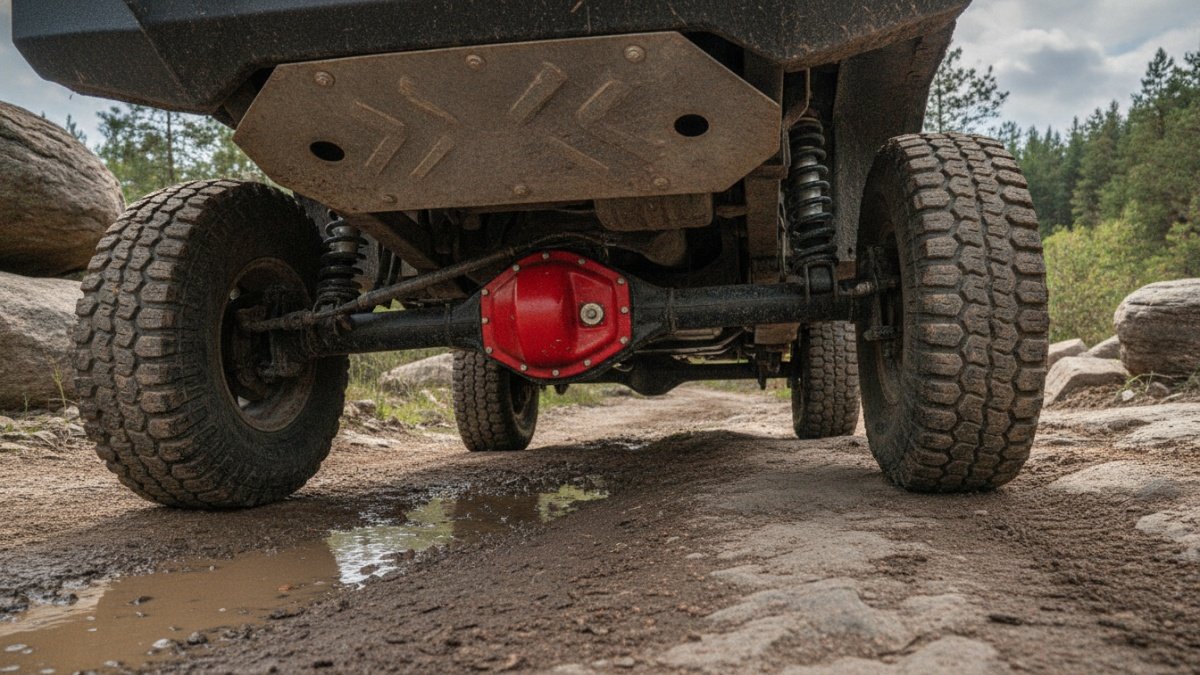
A locking axle changes a car's off-road behavior more dramatically than a lift and tires combined, and it wears out the rest of the drivetrain the quickest of all modifications. In the workshop, we see both scenarios: cars that, after being fitted, no longer get stuck where they were before, and those that return a month later with a broken driveshaft. The difference is rarely the brand, more often the result of which model was used in which car and what was done to the rest of the drivetrain.
How does a differential lock work off-road?
An open differential distributes torque evenly, which sounds fair, but off-road it works against the driver. The torque transferred to the entire axle limits the wheel with the least traction. When one wheel becomes suspended in the air at a junction, the planetary gears in the basket begin to spin, escaping into the void, and the wheel on the ground receives zero traction.
A differential lock eliminates this problem at its source. The planetary cage is rigidly connected to the axle shafts, so both wheels rotate at the same speed regardless of the terrain. The wheel with the better ground then absorbs as much torque as it can mechanically withstand. This is the advantage of a differential lock.
Torque distribution in three systems when one wheel of an axle loses traction:
| System | Torque per wheel with grip | Behavior on asphalt |
| Open differential | around 0% | neutral |
| Disc or Torsen LSD | 20-40% axle torque | almost neutral |
| Full Lock 100% | to the limit of the axle shaft's strength | picks up when turning |
We have collected variants selected for specific axles, gear ratios and the number of splines in the category locks and differentials; the selection starts with the identification of the bridge, not with the budget.
Pneumatic, electric, cable or automatic lock?
The engagement method is more important than the design of the dog clutch itself, as it determines whether the lock will engage when you need it. The Air Locker pneumatic lock operates on compressed air: a piston presses the clutch inside the basket, and until the button is pressed, the mechanism behaves like a standard differential. The installation is expensive: a compressor, reservoir, hoses, and a swivel joint in the axle housing.
An electric lock uses an electromagnet or a motor with a push rod instead of air. Fewer components, simpler wiring, and shorter installation time. However, it's less resilient to muddy and flooded conditions, as the pressure in a pneumatic system automatically forces contaminants out of the seal area.
Cable-operated steering is the oldest and most resistant: without electronics or air, but with the problem of routing the cable in a car after a facelift. A separate group of automatic locks are the Detroit Locker and cheaper lunchbox inserts, which engage automatically and release the outer wheel on a curve.
What works for crossings and what works for expeditions?
This distinction can be counterproductive. A car can cover a dozen or so kilometers a day on a road trip, but the locking mechanism works for half that time. An automatic transmission like the Detroit Locker is unrivaled here: there's nothing to break or flood, it works even with a dead electrical system, while a competitor with a damaged air hose simply stalls. In an expedition vehicle that covers several thousand kilometers of asphalt en route to its destination, the same automatic transmission becomes a nuisance: it skids when changing gas, accelerates rear tire wear, and can pull the rear out on a wet curve. For road trips, an engaged locking mechanism makes more sense, leaving it disengaged for most of the journey.
Before a product is named, we check four things with the client:
Only after these answers do we move down to the catalog level. Reversing the order usually results in the bridge being moved a second time.
What breaks after installing a rear axle lock?
The lockup adds nothing to the engine's torque; it simply stops it from being wasted. Components previously operating at half capacity suddenly experience full load, shock-like stress, when traction is lost under the wheel. The failure sequence is repeatable, and it's best to understand it before purchasing.
The weakest link is often the axle shaft, or more precisely, its splines at the crown wheel. Off-roaders with a 30-spline axle on 30-inch tires can handle it, but the same axle with a locking system and 33- or 35-inch tires starts to twist the axle shafts at junctions and when landing off a bump. Switching to a 33-spline version made of chrome-molybdenum steel increases torsional strength by 30-40% and usually seals the deal for years. We've described kits for popular axles in the category reinforced half-shafts.
Next in line is the driveshaft spider, and third comes the final drive, meaning the plate and the drive. Failure here is rarely sudden; more often, it's a growing whine following a change in the backlash. The correct backlash for most bridges is between 0.13 and 0.20 mm and must be reset after each disassembly of the mechanism.
The order of amplification follows directly from this failure hierarchy:
Reversing this order shifts the weakest link to a worse location. A broken driveshaft means a stoppage on the road, a broken final drive means the entire axle has to be dismantled.
When is an LSD differential enough and when do you need a full lockup?
The limit is where the wheel leaves the ground. As long as all four wheels have some contact with the ground, the LSD differential does its job: transferring 20-40% of torque from the axle to the wheel with traction, operating without driver intervention and without changing the car's behavior in corners. This is sufficient for sand, wet grass, ruts, snow, and most forest driveways.
When a wheel hangs in the air, the LSD loses its power because it needs a difference in resistance to transfer torque, not a lack thereof. Crossroads, deep ruts, and rock steps require full lockup. Therefore, a car with two LSDs can stop where an older vehicle with a single rear lockup would drive without stopping.
What is the difference between a disc LSD and a Torsen and an automatic cartridge?
A disc LSD locks up via a clutch pack of friction clutches, compressed by springs and the satellites. It's predictable, but it wears out: after 80,000-120,000 kilometers, the discs lose their pressure, and the mechanism behaves almost like an open clutch. Rebuilding it involves replacing the clutch pack and springs. Torsen operates mechanically, without friction discs, so it doesn't wear out, but it refuses to engage when there's zero resistance on one wheel. The automatic insert locks up in the 100% and only releases when the outer wheel overtakes the inner wheel. Clicking pawls heard during parking maneuvers are not a malfunction.
Rear axle or front axle lock: where to start installation?
We always start from the rear. Locking the rear axle gives you the biggest boost for your money, as the rear axle carries more weight off-road, and additional pressure is transferred to it when climbing. On firm ground, the car lifts slightly when turning, but the steering remains neutral.
| Criterion | Rear lock | Front lock |
| Influence on management | lack | increases the turning radius |
| Risk to joints | low | high when turning |
| Operating mode | longer episodes | point by point, against the obstacle |
The front axle lock is a different story. Engaged with the wheels turned, it stiffens the axle and transfers all the torque to the joints operating at an angle, their weakest point. The car tracks straight even with the steering wheel turned, which can be dangerous on a rocky step. Therefore, the front axle lock is engaged a few meters before the obstacle and disengaged immediately after it has been cleared.
A sensible plan is to split it into two seasons: the first year is the rear and tires, the second year is the front, once you know the vehicle will be driven in terrain that requires both axles. You can find kits for specific axle models in the category bridge blockades, and we verify the selection by the axle number and gear ratio, not by the year of the car.
When budgeting for 2026, remember the labor cost: just installing the locking device requires 6-10 hours of workshop time, including setting the engagement and clearance. A locking device purchased cheaper but installed without measuring the engagement and clearance will whine after 2,000 kilometers and return to the bench.
Xtreme4x4
Proven parts for many car models. Fast shipping and professional service. We offer consumables, braking systems, suspension, and accessories. Choose the right parts conveniently, safely, and at a great price.
piotr@xtreme4x4.pl
