
Beadlock Rims: What They Are and When They Really Come in Handy
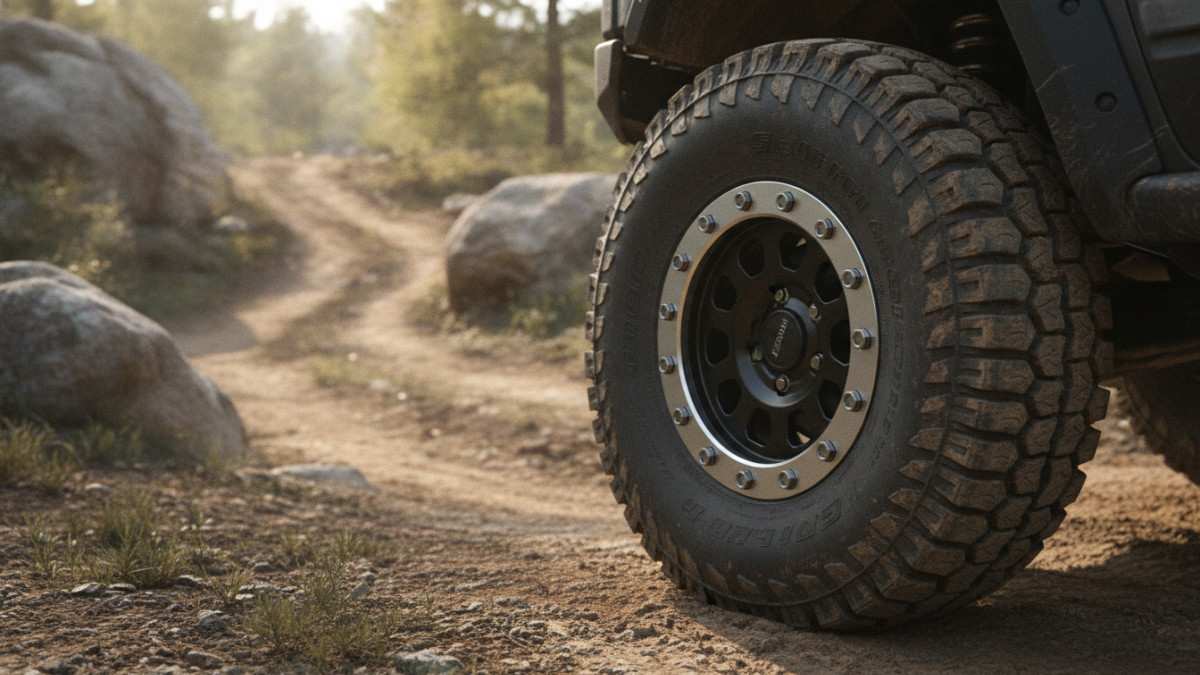
Beadlock rims are rims with a mechanism that presses the tire bead against the rim, preventing the tire from slipping even at very low pressure. At our workshop in Świdnik, we primarily install them on cross-country and adventure vehicles, but after years of building off-road vehicles, we know one thing: amateurs rarely need them. In this post, we explain what a beadlock is, how it works, and when it makes sense and when it's just an overpriced gimmick.
What is a beadlock and how does it actually work?
A beadlock is a compression ring that mechanically holds the tire bead to the rim flange using a series of screws. In a conventional rim, the tire bead is held to the rim solely by the air pressure inside. Deflate below a certain threshold, and the bead will separate from the flange, causing the tire to rotate relative to the rim or come off the rim altogether. A beadlock eliminates this problem because the tire is physically clamped, regardless of how much air is left inside.
In practice, it works like this: a removable ring is placed over the outer bead of the tire and secured to the rim with several dozen screws. The number of screws depends on the manufacturer and diameter, typically ranging from 24 to 32 per wheel. They press the bead against the rim flange with such force that the tire remains securely seated even when the pressure drops to 0.3 to 0.5 bar. By comparison, the safe limit for a standard off-road rim is approximately 0.8 to 1.0 bar.
Internal or external beadlock?
There are two construction solutions and it is worth distinguishing them when purchasing:
- The external beadlock, a visible ring bolted to the rim face, is the most popular, easiest to use and maintain, and is typical for off-road use.
- Internal beadlocks, hidden inside the wheel and invisible from the outside, tighten the inner bead of the tire, providing a cleaner appearance but making servicing more difficult.
- Double beadlock, a version that clamps both beads simultaneously. Used in the most demanding applications, such as on touring vehicles with large-diameter tires.
We most often install external beadlocks on our customers' cars because they're easier to service off-road and easier to change the tire after returning from the road. Internal beadlocks look elegant on the road, but when you need to quickly remove a tire while traveling far from the workshop, they become a pain. Choosing a specific type is worth consulting with someone who has actually assembled such wheels, as each variant handles mud and sand differently.
When do beadlock hoops actually come in handy?
Beadlock rims are useful where you regularly lower the pressure below 0.8 bar for increased traction, such as on cross-country trails, sand, and rocks. The technique of lowering the pressure off-road, called airing down, works brilliantly because it flattens the tire and creates a larger contact patch. The problem is, the lower you lower the pressure, the easier it is for a standard rim to shear a bead when you jerk the handlebars or hit a rock sideways.
From our rally experience, beadlocks make real sense in several scenarios: in cross-country rallies, where the car drives at 0.3 to 0.5 bar for hours and there's no time to inflate a flat tire; in deep sand dunes, where maximum contact area is key; and on rock crawling, where the wheel operates at extreme angles. In all these cases, a bead break means air loss and the end of the ride, and a beadlock practically eliminates this risk.
It's worth adding some context from the road. A cross-country vehicle with 0.4 bar can handle terrain where the same vehicle with 1.8 bar would simply sink into the ground because the tire wouldn't engage the ground. The difference in traction can be enormous, but as pressure drops, the risk of bead breakage increases with every sharp turn. Beadlocks allow you to go that low without that fear, and that's its entire value, something you won't find in any ordinary rim.
For whom is this a triumph of style over substance?
Honestly, for most off-roaders, beadlocks are unnecessary. If you ride mostly on asphalt, hit forest trails, and occasionally hit light mud, a standard, sturdy off-road rim will be perfectly adequate. The benefits of beadlocks only become apparent at pressures that no one uses on a daily basis, and then there are the costs and responsibilities, which we'll discuss below.
A significant portion of the market is also occupied by so-called "dummy" rims, which are rims with a beadlock-like ring attached solely for appearance. This ring doesn't clamp anything; the tire grips the rim normally, at normal pressure. If you're looking for function over style, be sure to check whether the ring actually clamps the bead or is merely decorative. Even experienced buyers make mistakes here.
How is a beadlock different from a regular rim?
Beadlock differs from standard rims primarily in the way the tire is held, the allowable operating pressure, and its legal status on public roads. The table below summarizes the key differences, which we discuss with our customers before deciding to retrofit their vehicle.
| Criterion | Regular off-road rim | Beadlock rim |
| Holding the tire | Air pressure | Mechanical ring pressure |
| Safe minimum pressure | approx. 0.8 to 1.0 bar | up to 0.3 to 0.5 bar |
| Approval for public roads | Standard, available | Most often missing (track/terrain) |
| Balance | Simple, routine | More difficult, sometimes static |
| Price per unit (2026) | from approx. 250 to 600 PLN | from approx. 800 to 2000 PLN |
| Typical use | Everyday riding, light off-road | Crossings, sand, rocks, rallies |
The table highlights the most important point: beadlocks are a tool for a specific task, not a universal upgrade. You pay more, gain durability at extremely low pressures, but lose the convenience of legal asphalt driving and easy maintenance. It's a compromise that's only worthwhile if you actually take advantage of this one advantage.
What to remember before buying beadlock rims?
Before purchasing beadlock wheels, check the roadworthiness, balance, and bolt torque, as these are the three most common sources of problems. We'll start with the legal aspect, as it can be surprising. The vast majority of beadlock wheels available in Poland are not approved for public roads and are formally intended for use on tracks or in closed areas. This poses a risk during road inspections and may result in problems with your insurer in the event of an accident. Before purchasing, it's worth verifying the wheel's approval certificate, as counterfeits from reputable brands without valid certificates are also circulating on the market.
The second issue is balancing and maintenance. The ring of bolts complicates wheel balancing; some garages only balance beadlocks statically, and the bolts themselves require tightening to the correct torque, evenly and crosswise, according to the manufacturer's specifications. Loose or unevenly tightened bolts result in leaks and vibration. Weight should also be considered, as beadlocks are heavier than standard rims, which impacts suspension and fuel consumption.
We also factor in the maintenance costs. We check the beadlock bolts regularly, as they can loosen from shocks off-road and corrode quickly in mud. After every major ride, we check the torque and thread condition, sometimes replacing individual bolts. This isn't a rim you just put on for years and forget about. You're taking on a bit more maintenance, and it's good to know that from the start.
How to choose beadlock rims for your car?
We always start our selection with how you actually use your car, not the rim's appearance. If your trips involve real-world driving with air pressure down to 0.5 bar or lower, beadlocks will do the trick. If these are weekend forest rides, it's better to invest in sturdy off-road rims and good tires. The size, bolt pattern, and offset should always be appropriate for the specific vehicle model, so it's worth discussing this step with a mechanic.
You can find the full range of rims and tires in our category rims and tires, and if you want to better understand the topic of lowering pressure in the field, we recommend the entry about off-road tire pressure. If you need beadlock installation or advice on whether they make sense for your car, please email or call us through our website. contact. We'll build wheels to suit your driving style, not a pretty picture from the internet.
Beadlock rims: who makes sense for them and who doesn't?
Beadlock rims are a narrowly specialized solution that excels in cross-country riding, sand, and rocks. Outside of these applications, they usually cause more problems than benefits. Mechanical bead pressure allows you to ride at pressures that would cause a regular tire to slip off the rim long ago, but the trade-off is a lack of homologation, more difficult balancing, increased weight, and a significantly higher price. For rally racers and adventurers, they're often an investment worth every penny. For drivers who primarily ride on asphalt with the occasional off-road excursion, a good, standard off-road rim with a suitable tire will be a more sensible choice. If you're unsure which group you fall into, just ask someone who builds these wheels daily.

Xtreme4x4
Proven parts for many car models. Fast shipping and professional service. We offer consumables, braking systems, suspension, and accessories. Choose the right parts conveniently, safely, and at a great price.
piotr@xtreme4x4.pl
